
IoT systems are growing rapidly, connecting thousands of devices across cities, factories, farms, and logistics networks. Managing such growth demands scalable, reliable connectivity. A 4G LTE CAT I HAT with Raspberry Pi5 provides a solution. It adds cellular connectivity to the Raspberry Pi5, allowing devices to operate remotely without local networks. This article explains, from a technical perspective, how such a setup enhances scalability in IoT deployments, its advantages, challenges, and real-world applications.
Understanding 4G LTE Cat‑1 and Raspberry Pi5
A 4G LTE CAT I HAT with Raspberry Pi5 enables scalable IoT with wide coverage, reliable connectivity, secure communication, and cloud integration.
What Is a 4G LTE Cat‑1 HAT?
A 4G LTE Cat‑1 HAT is a hardware add-on designed for Raspberry Pi boards. It integrates a cellular modem and antenna interface, enabling LTE Category‑1 connectivity. LTE Cat‑1 supports speeds up to 10 Mbps downlink and 5 Mbps uplink, which is sufficient for many IoT applications such as sensor telemetry, remote monitoring, and control signals.
Raspberry Pi5 Overview
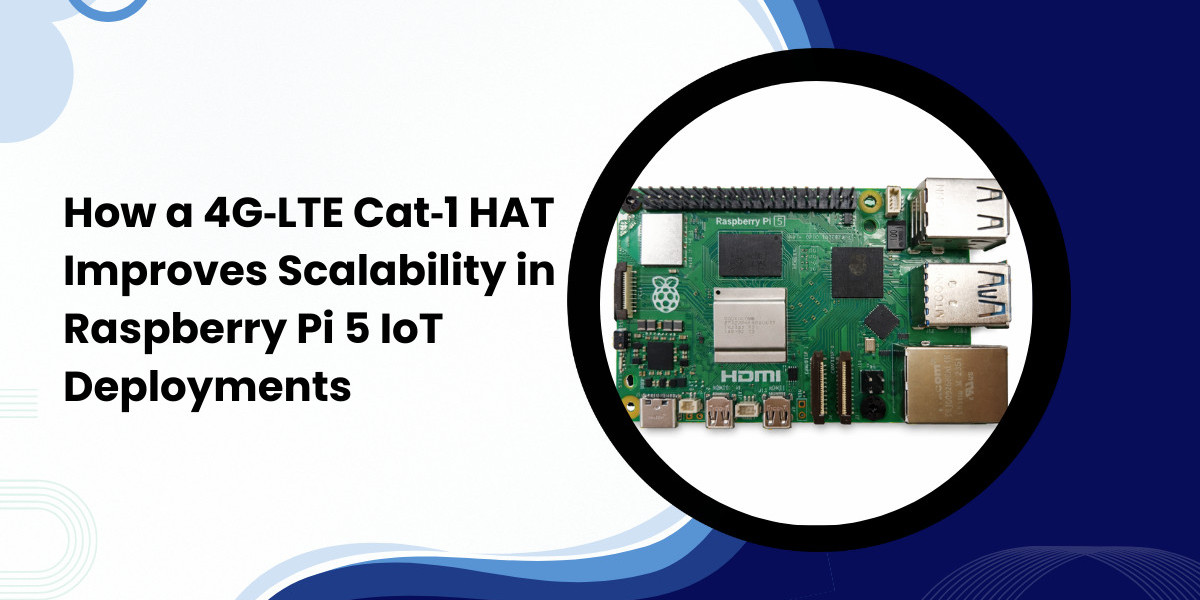
The Raspberry Pi5 with 4G LTE CAT I HAT becomes a compact IoT node or gateway. It combines the Pi’s general-purpose computing capabilities with cellular connectivity. The Pi5 features faster CPU performance, more memory options, and high-speed USB interfaces, making it suitable for data processing at the edge. When paired with LTE Cat‑1 connectivity, it can transmit and receive data over wide areas reliably.
Why Connectivity Drives IoT Scalability
Scalability in IoT means adding more devices or nodes without redesigning the network. The number of connected IoT devices is expected to exceed 14 billion by 2026. Reliable connectivity is critical to ensure consistent data flow across all devices. Cellular networks are inherently scalable because they can handle a large number of devices over wide geographic areas.
The Raspberry Pi5 with 4G LTE CAT I HAT leverages cellular infrastructure, removing the need for local networking equipment such as Wi-Fi access points, repeaters, or wired Ethernet. This makes deployments faster, easier, and more uniform.
Technical Advantages of LTE Cat‑1 for IoT
1. Wide Area Coverage
Cellular LTE Cat‑1 networks provide coverage in urban, suburban, and rural areas. Unlike Wi-Fi, which has limited range, a 4G LTE CAT I HAT with Raspberry Pi5 allows devices to transmit data across kilometers without requiring additional networking infrastructure.
This is especially useful for applications such as:
Environmental monitoring in remote farms
Fleet tracking across cities
Pipeline or utility monitoring over large regions
With LTE Cat‑1, a single network plan can support hundreds or thousands of devices across multiple regions.
2. Efficient Data Rates for IoT
LTE Cat‑1 supports moderate bandwidth sufficient for most IoT workloads. While not as fast as LTE Cat‑4 or 5G, Cat‑1 offers a balanced trade-off between speed and power consumption. It can transmit telemetry data, images from low-resolution cameras, GPS coordinates, and small control commands without congestion.
For example, a Raspberry Pi5 with 4G LTE CAT I HAT can send temperature and humidity data from 500 sensors simultaneously to a cloud server using MQTT or HTTP protocols. This ensures scalability without overloading the network.
3. Lower Power Consumption
LTE Cat‑1 devices are designed to consume less power than higher-speed LTE categories. In battery-powered IoT deployments, energy efficiency is critical. Reduced power consumption allows devices to operate for weeks or months on battery or solar power.
This enables scalable deployments without expensive power infrastructure. Multiple Raspberry Pi5 nodes with LTE Cat‑1 HATs can operate across remote sites without daily maintenance.
4. Standardized Interface
Most LTE Cat‑1 HATs use standard interfaces like UART, USB, and GPIO. The Raspberry Pi5 with 4G LTE CAT I HAT can communicate using AT commands or network managers in Linux. Standardized interfaces simplify software integration, enabling consistent configuration across multiple devices.This allows large-scale deployment scripts to automate device provisioning, network registration, and firmware updates efficiently.
5. Secure and Reliable Connectivity
Cellular networks provide built-in security through SIM-based authentication and encryption. Each Raspberry Pi5 node with LTE Cat‑1 can:
Authenticate securely on the network
Use VPN tunnels for private cloud connections
Encrypt data in transit without additional hardware
Security and reliability reduce the operational overhead of scaling thousands of IoT nodes.
How LTE Cat‑1 Supports Scalable IoT Architecture
LTE Cat‑1 enables scalable IoT by providing reliable, wide-area connectivity, centralized data collection, remote management, cloud integration, and efficient power usage.
1. Centralized Data Collection
Raspberry Pi5 nodes with LTE Cat‑1 HATs can transmit data directly to a central server or cloud platform. This eliminates the need for local aggregation networks. All nodes can follow the same configuration for:
Sampling rate
Message payload format
Transmission intervals
Uniformity simplifies scaling to hundreds or thousands of devices.
2. Remote Device Management
LTE connectivity allows remote updates and monitoring. Engineers can push firmware, adjust configuration, and troubleshoot devices from a central location. This is crucial in large deployments where on-site maintenance is costly or impractical.
For example, a fleet of Raspberry Pi5 sensors deployed in multiple cities can receive OTA (Over-The-Air) updates via LTE Cat‑1 without any local IT support.
3. Integration with Cloud and IoT Platforms
A Raspberry Pi5 with 4G LTE CAT I HAT can connect to IoT platforms like AWS IoT Core, Azure IoT Hub, or Google Cloud IoT. LTE ensures devices remain online, enabling:
Real-time analytics
Event-driven alerts
Scalable dashboards across thousands of devices
Cloud integration simplifies managing and scaling industrial, commercial, and environmental IoT projects.
Real-World Use Cases
1. Industrial Automation
Factories with multiple plants or equipment sites benefit from LTE Cat‑1. Raspberry Pi5 nodes with LTE HATs can:
Monitor machinery performance
Trigger predictive maintenance alerts
Send aggregated data to central control systems
Scalability is achieved by deploying additional nodes without modifying the network infrastructure.
2. Smart Agriculture
In agriculture, IoT nodes measure soil moisture, temperature, and crop health. A 4G LTE CAT I HAT with Raspberry Pi5 enables:
Remote sensor deployment over large farms
Real-time irrigation control
Reduced network setup costs
LTE Cat‑1 coverage ensures nodes function across remote fields without relying on Wi-Fi or wired networks.
3. Fleet Management
Vehicles or shipping containers can carry Raspberry Pi5 devices with LTE Cat‑1 HATs. These devices track GPS coordinates, status, and environmental conditions. Scalable deployment is possible because cellular networks handle mobility, handovers, and multiple simultaneous connections.
Deployment Considerations
1. SIM and Data Plans
Scalable deployments require efficient SIM and data management. IoT-specific plans often cost under $5 per device per month, making large deployments feasible. Bulk SIM management platforms help automate provisioning and monitor data usage across thousands of devices.
2. Antenna Placement
Signal quality is crucial for scalability. LTE HATs include external antenna ports. Proper placement ensures:
Stable connectivity in indoor or underground areas
Consistent data transmission for all devices
Minimal packet loss across wide deployments
3. Network Congestion
LTE networks may experience congestion in high-density deployments. LTE Cat‑1 modems often support Quality of Service (QoS) settings. Proper network planning ensures predictable latency and throughput across multiple devices.
Examples of Scalable IoT Systems with LTE Cat‑1
1. Environmental Monitoring
A network of 1,000 Raspberry Pi5 nodes with LTE Cat‑1 HATs collects air quality and temperature data in a city. Data is sent every minute to a cloud server for analysis. Deployment benefits:
Centralized monitoring dashboard
Minimal on-site configuration
Easy expansion by adding new nodes
2. Industrial Plant Network
A manufacturing company deploys 200 Raspberry Pi5 devices with LTE Cat‑1 HATs to monitor production lines. Benefits include:
Predictive maintenance alerts
Reduced downtime
Scalable architecture ready for future expansion
3. Smart Transportation
A logistics company equips 500 trucks with Raspberry Pi5 LTE nodes to track shipments. LTE Cat‑1 allows:
Real-time location tracking
Environmental monitoring inside containers
Centralized data analysis for fleet optimization
Conclusion
A 4G LTE CAT I HAT with Raspberry Pi5 enhances IoT scalability by providing wide-area coverage and reliable connectivity for telemetry, control, and monitoring. Standardized interfaces simplify integration, while SIM-based authentication ensures secure communication. Remote management and cloud integration enable centralized updates. LTE Cat‑1 balances bandwidth, power efficiency, and cost, making it ideal for industrial, agricultural, transportation, and environmental IoT systems, allowing networks to expand from a few nodes to thousands efficiently.