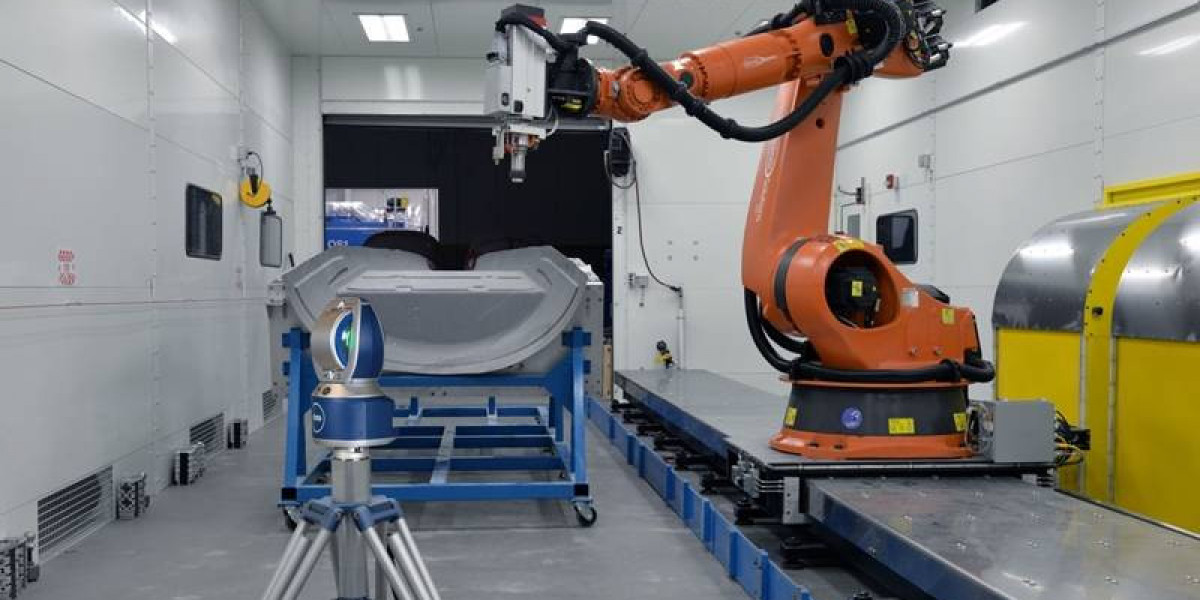

In modern manufacturing, precision is everything. Whether you’re assembling an aircraft fuselage or building high-performance automotive components, even the smallest measurement error can lead to costly setbacks. This is where Laser Trackers come in — providing exceptional accuracy and reliability for large-scale measurement and alignment tasks.
These advanced systems have revolutionized industries that demand pinpoint precision, offering real-time feedback and automated inspection capabilities that streamline production and ensure consistent quality.
What Is a Laser Tracker?
A laser tracker is a state-of-the-art portable coordinate measuring system that uses laser beams to measure and inspect large objects with incredible precision. It works by tracking a reflective target (typically a spherically mounted retroreflector) as it moves around an object, calculating three-dimensional coordinates in real-time.
Unlike traditional measurement tools, laser trackers offer a combination of speed, mobility, and sub-millimeter accuracy — ideal for large-scale production environments where components can span several meters in length.
Why Laser Trackers Matter in Modern Manufacturing
Large-scale production environments such as aerospace, shipbuilding, and energy industries rely heavily on precision alignment and quality assurance. Traditional measurement methods like tape measures or fixed coordinate measuring machines (CMMs) often lack the flexibility and speed required for massive assemblies.
Laser trackers bridge this gap by allowing technicians to take fast, accurate measurements directly on the shop floor. They ensure that parts fit together perfectly, tolerances are maintained, and production runs smoothly from start to finish.
This combination of mobility, accuracy, and efficiency makes laser trackers an indispensable tool in advanced manufacturing and engineering applications.
How Laser Trackers Work
At their core, laser trackers operate using a laser interferometer or absolute distance meter to calculate the exact position of a target in 3D space. Here’s a simplified breakdown of the process:
The laser tracker emits a laser beam that locks onto a reflective target (SMR).
As the operator moves the target around the component, the tracker continuously measures distance and angles.
The system calculates the exact 3D coordinates of each measured point.
Specialized software converts these measurements into detailed models or verifies them against CAD data.
This process allows manufacturers to identify deviations, confirm alignments, and verify dimensional accuracy in real time.
Key Benefits of Using Laser Trackers
1. Unmatched Precision
Laser trackers deliver accuracy within microns, ensuring every measurement meets stringent quality standards.
2. Time Efficiency
They significantly reduce inspection and setup times, allowing engineers to perform quick checks without disassembling parts.
3. Versatility
From measuring aircraft wings to wind turbine blades, laser trackers can handle a wide range of applications.
4. Real-Time Data Feedback
Instant data visualization allows operators to correct alignment errors immediately during assembly.
5. Cost Savings
By minimizing rework and scrap, laser trackers help reduce material waste and lower overall production costs.
6. Mobility
Portable and easy to set up, laser trackers can be used directly on the production floor or in the field.
Applications of Laser Trackers Across Industries
Laser trackers are used in almost every major industrial sector where precision and consistency are vital. Here are a few key examples:
Aerospace Industry
The aerospace sector depends heavily on precision. Laser trackers are used for component alignment, fuselage assembly, and inspection of complex geometries. They ensure aircraft parts meet strict safety and performance standards.
Automotive Manufacturing
In automotive production, laser trackers verify the alignment of body frames, robotic tools, and assembly fixtures. This ensures each vehicle meets exact design specifications, improving overall quality.
Energy Sector
From power generation equipment to wind turbines, laser trackers help measure and align massive components, ensuring optimal efficiency and performance.
Shipbuilding and Marine Engineering
Ship hulls and large structural assemblies require accurate alignment. Laser trackers allow engineers to measure these structures efficiently, even in challenging environments.
Heavy Machinery and Industrial Equipment
Laser trackers provide the precision required for the installation, calibration, and maintenance of large-scale machinery and production systems.
Enhancing Quality Control with Laser Trackers
Quality control is at the heart of manufacturing, and laser trackers have become a game-changer in this area. By integrating tracking data with digital inspection software, manufacturers can quickly verify product dimensions against CAD models.
This process detects even the smallest deviations before they become major defects, allowing for immediate corrections. The result? A consistent, repeatable manufacturing process that meets the highest standards of precision and compliance.
Furthermore, laser trackers support non-contact measurement, reducing the risk of damaging sensitive components during inspection.
The Role of Laser Trackers in Automation
Automation and laser measurement technologies go hand in hand. Many modern production lines now integrate laser trackers with robotic systems to automate inspection and assembly processes.
For instance, laser trackers can guide robotic arms in real-time, ensuring tools or components are positioned with exact precision. This level of automation not only boosts productivity but also improves repeatability — crucial in industries like aerospace and automotive manufacturing.
As industrial automation evolves, Laser Trackers are becoming key players in smart factories, where measurement, inspection, and quality control are seamlessly connected through digital ecosystems.
Comparing Laser Trackers to Traditional Measurement Tools
Traditional measurement systems like fixed CMMs or optical scanners are often limited by their working volume and immobility. Laser trackers, however, excel in scenarios requiring flexibility and large-scale reach.
Working Range: Trackers can measure objects up to 80 meters or more, far surpassing most CMM capabilities.
Portability: Unlike fixed systems, trackers can be moved easily between workstations.
Speed: Laser trackers provide faster data acquisition and on-the-spot analysis.
In short, laser trackers deliver the same (or better) accuracy as traditional tools while offering the mobility and convenience modern manufacturing demands.
Integration with Digital Manufacturing Systems
One of the biggest advantages of laser trackers is their seamless integration into digital manufacturing and Industry 4.0 ecosystems. Data collected from laser trackers can be linked with CAD/CAM software, digital twins, and PLM (Product Lifecycle Management) systems.
This digital connectivity enhances traceability, streamlines production workflows, and enables predictive maintenance — ensuring that manufacturing operations remain efficient, connected, and future-ready.
Leading automation specialists like Expert Technologies Group are at the forefront of integrating laser measurement systems into smart production environments, helping businesses maximize accuracy, efficiency, and traceability.
Challenges and Considerations in Laser Tracker Implementation
While the advantages are clear, there are a few challenges manufacturers should be aware of when adopting laser tracking systems:
Environmental Conditions: Dust, vibration, or temperature fluctuations can affect measurement stability.
Operator Training: Skilled personnel are needed to ensure accurate setup and calibration.
Initial Investment: Laser trackers represent a high-end technology, but the long-term ROI justifies the cost.
Fortunately, with proper training and implementation strategies, these challenges are easily overcome — unlocking the full potential of this advanced measurement technology.
Future Trends in Laser Tracker Technology
The evolution of laser tracking technology continues to push boundaries. Future systems are expected to feature:
Higher Accuracy Levels: Innovations in optical technology and sensors will deliver even finer measurements.
Enhanced Portability: Smaller, lighter, and more battery-efficient designs.
AI Integration: Intelligent data analysis and real-time anomaly detection.
Wireless Operation: Improved connectivity for faster, cable-free data transfer.
Augmented Reality Visualization: Real-time overlay of measurement data in AR for on-site inspection and training.
As these innovations mature, laser trackers will become even more indispensable in precision engineering and large-scale production.
Conclusion: The Future of Precision Measurement
In industries where accuracy defines success, Laser Trackers are setting a new benchmark for precision, productivity, and quality assurance. From aerospace to automotive, these advanced tools are reshaping how manufacturers measure, align, and verify complex structures — saving time, reducing costs, and ensuring consistency across every production stage.
Whether used for inspection, calibration, or automation, investing in Laser Trackers is an investment in the future of efficient, high-precision manufacturing. As technology continues to evolve, these systems will remain central to achieving excellence in large-scale engineering and production.