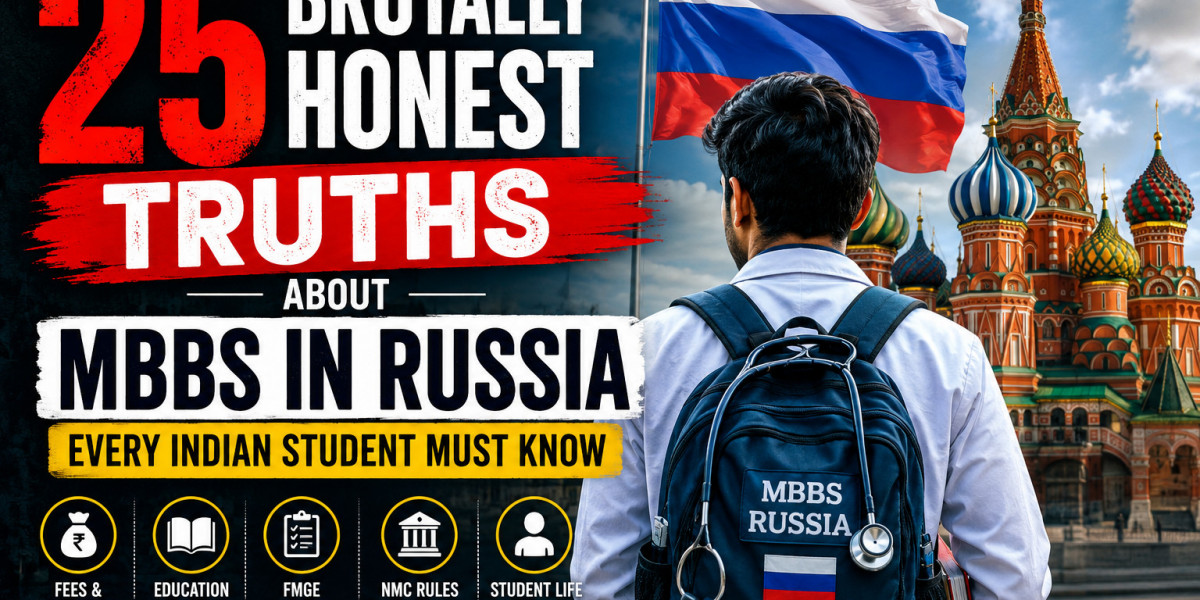

Many Indian students choose to study for MBBS in Russia every year thanks to its affordable tuition, NMC-listed colleges, and easy admission process. For the thousands of NEET qualified Indians who didn't make it to government medical colleges in India, pursuing MBBS in Russia is a preferred option. Beyond these bright prospects of inexpensive MBBS with a low-cost, English medium curriculum and international recognition, here are a few honest truths about MBBS in Russia you must know.
We bring you 25 honest truths about MBBS in Russia, from academics, clinical exposure, and FMGE/NEXT preparation to life in Russia.
Why Students Choose Russia for MBBS
There are over 20,000 Indian students in Russia. The eight most common reasons:
Low tuition fees compared to India
No donation or capitation fees
NEET is the only mandatory exam
No IELTS/TOEFL required
English-medium teaching available
NMC-recognized universities
WHO-listed degrees (WDOMS)
Large Indian student community
Fixed 6-year MBBS program as per NMC guidelines
Before We Begin: Who Should Read This Guide?
This guide is for NEET-qualified students, whether they are parents helping their children make the final decision or students debating Russia against Kazakhstan, Georgia, or Uzbekistan. If you want honest answers rather than sales pitches, read on.
Truth #1: Russia Is Not the Cheapest MBBS Abroad Option Anymore
Five years ago, MBBS in Russia was definitely one of the cheapest destinations to pursue MBBS abroad. Times have changed, countries like Bangladesh, Kyrgyzstan, and some universities in Uzbekistan charge less than or equal to that. Russia's total 6-year cost sits between ₹25 lakh and ₹50 lakh, depending on the university. That is still 50–70% cheaper than private Indian MBBS, but it is no longer a bargain by default.
Truth #2: Learning Basic Russian Is Almost Mandatory
Teaching occurs in a classroom, and lessons in English. All else outside of that is in Russian, whether that’s in a hospital with staff or patients, in pharmacies, or on the street. Students who skip basic Russian struggle with clinical rotations and daily errands. Two or three semesters of Russian are part of the curriculum, but how much work you put in matters a whole lot more.
Truth #3: Patients Rarely Speak English During Clinical Training
These are facts that are learned in the moment when a student reaches the wards. It’s a fact; your hospital postings consist of patients who only speak Russian. Without a basic ability to get a history or carry out instructions in Russian, your Clinical learning skills won’t improve. Top students begin Russian conversation practice from Year 2, not Year 4.
Truth #4: Not Every Russian Medical University Is Equally Recognised
Russia has more than 60 universities where students can apply to study. Not all the Universities in Russia have been given NMC approvals. For students applying to study MBBS in Russia not on the NMC-approved list, you will not be eligible to sit for your FMGE/NExT in India. Always verify the university against the current NMC list before paying any fee.
Truth #5: University Rankings Don't Guarantee Better Clinical Exposure
Even highly placed, world-ranked universities will likely have insufficient clinical placement if they are in a small city with not enough tertiary care hospitals. The quality of Russian universities' clinical placement is more dependent on which city their university is situated in and not the actual ranking of the university in global ranking tables. Moscow and St. Petersburg universities naturally have access to larger, more specialized hospitals.
Truth #6: FMGE/NExT Preparation Is Largely Self-Driven
You learn medicine in Russian universities. They do not teach you FMGE or, for that matter, NExT exams coming soon. Top Russian universities may have had the FMGE coaching programs. It is an optional thing anyway.
The overall FMGE passing rate for Indian students who have completed medical degrees from Russian universities in 2024 is 29.54%. Students who pass have almost always begun systematic FMGE preparation from Year 4 or earlier, on their own initiative.
Truth #7: Cultural Adjustment Can Be Difficult Initially
Compared to India, Russian culture is relatively conservative. During the first six months in Russia, culture shock hits quite strongly. Being away from India is hard because the food will be different, you'll only understand the basics of the Russian language, and you'll be in a society where smiles are a privilege rather than the norm, which is generally harder for Indians.
Most students adjust within a year, especially in cities with a large Indian student community.
Truth #8: Russian Winters Are Tough for Many Indian Students
At -20°C or colder temperatures in such places as Kazan or Novosibirsk, it becomes for students coming from Southern India a very visible change, both physiological and mental. It is always advisable to start shopping for winter clothing at the earliest, before the first snowball falls and you realize you don’t own one.
Truth #9: Food Is a Bigger Challenge Than Most Consultants Admit
Major cities will have hostels as well as nearby Indian restaurants, in order to have constant access to your regular supply of authentic Indian meals could require a little work and possibly a small sacrifice (financially or otherwise). The adjustment is hardest on students from a vegetarian house. However, typically after the very first semester, a student will be more used to a lot of things.
Truth #10: Hostel Life Varies Significantly by University
Some Universities offer well-maintained, modern hostels with Indian food facilities, separate blocks for Indian students, and 24-hour security. Then, others look back on the photos and wish they'd let you put anything into the tiny room except your socks.
Don't take accommodation for granted, though, it really isn't a minor thing to spend six years living there. Ask for photos and speak to current students before deciding.
Truth #11: Clinical Exposure Depends More on City Than University
Some medical schools, on average, not elite Russian universities of Moscow and St. Petersburg, give better clinical experience to students than good medical schools in the provinces. Size of the hospital, the variety of patient profiles, available specialities and the number of cases available for each specialty should all come into play. Know your city.
Truth #12: Low Tuition Doesn't Mean Low Total Cost
Tuition fees vary from 2.5 lakh to 6 lakh per year. However, include the costs for the hostel, mess, winter clothes, health insurance, return trips to the house, pocket expenses, etc., and this cost increases to somewhere around 5-9 lakh per year. Over 6 years, you'll probably be looking at total costs in the range of 30-50 lakh, depending on the university and city. Budget early from day one, not only considering tuition.
Truth #13: Currency Fluctuations Affect Education Budget
INR to RUB has been unstable, particularly after 2022. While tuition fees will be charged in roubles or dollars for each year of your program, a depreciating Rupee translates into higher real costs in Rupee terms. Keep a 15-20% cushion in your 6-year financial plan.
Truth #14: Some Students Struggle With Academic Rigour
MBBS in Russia is never a bed of roses. During the first 2 years, we had anatomy, biochemistry, and physiology. This year went by at such a dizzying speed that one could barely manage.
The classes here are rushed and mostly made through russian textbooks, which is translated into English, but we had very lenient professors when they come to translation and writing the notes. Students who coast through the first semester often fall behind in Year 2. Start seriously from Day 1.
Truth #15: Attendance Rules Are Often Strict
Nearly all russian universities adhere strictly to the 75-85% attendance requirement and offer regular tests throughout the academic year. Absence would earn you fines, a need for retests, and possibly forced repetition of the year. The easy-go, study-abroad perception just doesn't work here.
Truth #16: Degree Recognition Rules Can Change
The NMC guidelines for foreign graduates were modified in 2021. You must be aware of the fact that NExT will soon be the ultimate exam for the FMGE candidate and likely be introduced from 2026-27. Regulatory frameworks may change your 6-year curriculum in Russia. So keep following NMC notices for at least quarterly updates.
Truth #17: Returning to India Requires Strategic Planning
Simply said, it's not the examination only. You must get your degree validated and transcripts to NMC and also complete a year-long internship in an NMC-approved hospital in India, after which you'll register in your respective State Medical Council. It will definitely consume time and money. You must prepare for it, starting from Year 5.
Truth #18: FMGE/NExT Pass Rates Vary Widely
The national average for Indian students from Russia is 29.54% in 2024; the range of variation varies dramatically between universities, with pass rates ranging from 40-50% in some of them to under 15% in others. Avoid choosing based purely on location or fee structure. Focus instead on FMGE results for each specific university.
Truth #19: Internship Recognition Needs Careful Verification
After completing your MBBS degree, you will need to undergo internship at an approved teaching hospital as per NMC regulations. There is a query about whether your internship done in Russia counts toward this or if you need an India-based internship, depending on what your university's rules & policies allow you to study and on the current guidelines of the NMC. Please do a thorough check in writing from both the NMC and the university before joining the course, not after finishing it.
Truth #20: Not Every Student Regrets Choosing Russia
All these truths aside, this is what the scales are balanced with - Many Thousands of Indian Students are returning from Russia; Cracked FMGE, the PG entrance examination, had a full career, nothing Russia did went wrong. It was entirely based on the students’ hard work and choice of their respective colleges.
Truth #21: Many Graduates Build Successful Careers
MBBS in Russia degree graduates are now practising all over India as well as abroad. Some Russian MBBS graduates are clearing FMGE on their very 1st attempt, some have bagged PG seats, some have also built some robust hospital careers. The degree is not a barrier, FMGE preparation and the right university selection are the real variables.
Truth #22: Russia Can Be a Better Option Than Private MBBS for Some Students
All Russian MBBS degree graduates are now practicing in India and even abroad. Many have cracked their first attempt at FMGE and got PG’s and a successful hospital life. The degree is not really a hurdle, as they come with an FMGE test preparation and selection of universities for admission in Russia.
Truth #23: Consultant Marketing Often Hides Challenges
Almost all admission consultants get commission from a set of universities. If they can push a specific university onto you to earn commission, then that’s exactly what they’ll do; the recommendations they make aren’t based on what would be best for you, your background, pocket, or your FMGE.
Truth #24: Choosing the Right University Matters More Than Choosing Russia
Russia is a destination, not a decision. The real decision is which Russian university you attend. Two students could pay almost the same amount of money and come to the same country to pursue the same course, but their careers could significantly differ based on the university. When you shortlist an MBBS in Russia, university, make sure you pick from a list of 3 to 5 NMC-approved ones.
Compare their results at FMGE, location, hostel availability, and clinical facilities before finalizing.
At EOCL India, you'll get direct admission assistance from Russian Universities, along with verified data and comparisons to simplify the decision-making.
Truth #25: MBBS in Russia Is Neither a Scam Nor a Guaranteed Success
Here is the 25 brutal truths of the MBBS course in Russia; this one is perhaps the most crucial one. Russia is not an easier way; it’s not a trap. It’s a real and challenging pathway to your dream medical career.
If you chose the right university, prepared really well for the FMGE regularly, and had a sound plan for post-graduation, then there's no limit to what you could do.
The students who arrive with expectations of an 'easy degree' eventually have problems.
MBBS in Russia: Pros vs Cons Table
Pros | Cons |
NMC-recognized and WHO-listed degrees (for eligible universities) | FMGE/NExT average pass rate 29.5% |
No donation or capitation fee | Language barrier |
50–70% cheaper than private MBBS in India | Winter conditions |
English-medium classroom teaching | Cultural differences between countries |
Large Indian student community | Some universities are reputed, others less known |
6-year MBBS program as per NMC guidelines | Currency fluctuation risk affecting total cost |
MBBS in Russia vs Private MBBS in India
Factor | MBBS in Russia | Private MBBS in India |
Total Cost | ₹25–50 lakhs | ₹50 lakhs–₹1.5 crore |
Donation | No donation required | Often ₹30–80 lakhs (in many private colleges) |
Duration | 6 years | 5.5 years |
Licensing Exam | FMGE / NExT required | Direct NMC registration |
Medium of Study | English + basic Russian (for clinical practice) | English |
Degree Recognition | Valid if the university is NMC-approved | Automatically valid in India (MCI/NMC recognized colleges) |
Common Mistakes Indian Students Make: MBBS in Russia
Choosing a university based only on low fees without checking the FMGE/NExT
Not learning the basic Russian language before going to Russia
Ignoring currency fluctuation while planning the total budget
Relying on only one consultant instead of doing personal verification
Starting FMGE/NExT preparation only in the final years (5th or 6th year)
Not checking the latest NMC approval status of the university
Not calculating the full cost of living beyond tuition fees
Not researching the city’s medical infrastructure and hospital exposure
MBBS in Russia Admission Guidance at EOCL India
When you apply for an MBBS seat in Russia after NEET, you have a lot of things to keep in mind. Rather than blindly opting for a low-fee package or a catchy marketing campaign, you have to carefully select a university.
NMC approval, FMGE or NExT performance, training in a hospital, and overall placement after completing the degree; all these are important.
EOCL India offers accurate and trustworthy counselling regarding admission to MBBS abroad, not only in Russia but also in Georgia, Kazakhstan, Uzbekistan, and Kyrgyzstan, among other countries. EOCL India guides you to different universities by assessing many factors, such as how many students pass FMGE exams annually, how good hospital training is, living costs, and the total cost of education. Contact EOCL India today for free MBBS abroad counselling session.
FAQs
1. Is MBBS in Russia worth it in 2026?
Yes, if you choose an NMC-approved university with a strong FMGE track record and commit to consistent exam preparation from Year 4 onward.
2. What are the biggest disadvantages of studying MBBS in Russia?
Low FMGE pass rate average (~29.5%), language barrier in clinical settings, harsh winters, and wide variation in university quality.
3. Is Russian language compulsory for MBBS students?
Not in the classroom, but practically mandatory for clinical rotations and daily life. Students who skip it struggle significantly during hospital postings.
4. Can Indian students practice in India after MBBS in Russia?
Yes, after graduating from an NMC-approved university, clearing FMGE or NExT, and completing a 12-month Indian internship.
5. What is the FMGE pass rate for Russian universities?
The overall pass rate for Indian students from Russia was 29.54% in 2024. Top universities like Kazan State Medical University reach 40–50%.
6. How much does MBBS in Russia cost in 2026?
Total 6-year all-in cost ranges from ₹25 lakh to ₹50 lakh, depending on university and city, including tuition, hostel, food, and living.
7. Is MBBS in Russia better than private MBBS in India?
For many students, yes — the cost saving of ₹30–80 lakh with no donation or capitation makes Russia the financially rational choice.
8. Which Russian medical universities are best for Indian students?
Sechenov University, RUDN, Kazan State Medical University, Kursk State Medical University, and Perm State Medical University are consistently cited for FMGE outcomes and Indian student support.
9. Are Russian MBBS degrees recognized in India?
Yes, degrees from NMC-approved Russian universities are recognised. Students must clear FMGE or NExT to get a practising licence.
10. What mistakes should students avoid before taking admission?
Avoid choosing solely on fee, skipping Russian language preparation, ignoring FMGE data by university, and relying on a single consultant without independent verification.