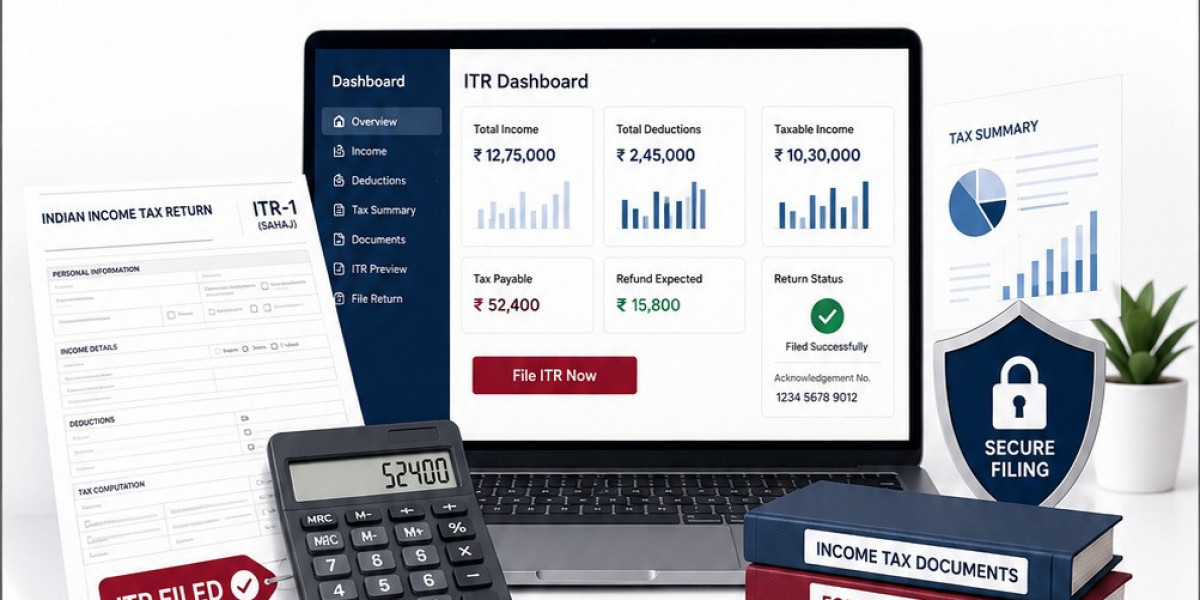

Filing an Income Tax Return (ITR) is a key responsibility for individuals, freelancers, and businesses in India. However, the process can feel complex due to changing tax laws, multiple income sources, documentation requirements, and strict deadlines. To simplify this, many taxpayers now rely on ITR Filing Services that handle the entire process professionally from start to finish.
Understanding how ITR Filing Services work helps taxpayers make better decisions, avoid mistakes, and ensure smooth, compliant, and timely tax submission.
This complete guide explains the working process of ITR Filing Services, step by step, so you know exactly what happens when you use them.
What Are ITR Filing Services?
ITR Filing Services are professional tax solutions offered by chartered accountants, tax consultants, and online platforms that assist taxpayers in preparing, reviewing, and filing income tax returns.
These services are designed to:
- Simplify tax filing
- Ensure accuracy in reporting
- Reduce compliance risks
- Help maximize eligible deductions
- Speed up return submission and refunds
Instead of handling tax filing alone, taxpayers get expert assistance throughout the process.
Who Uses ITR Filing Services?
Different categories of taxpayers benefit from ITR Filing Services, including:
Salaried Individuals
Employees with Form 16, investments, and multiple deductions.
Freelancers and Gig Workers
Individuals with irregular income and multiple clients.
Business Owners
Small and medium businesses managing expenses, revenue, and compliance.
Investors
Taxpayers with income from stocks, mutual funds, property, or capital gains.
Each category has different tax complexities, which makes professional support useful.
Step-by-Step Process: How ITR Filing Services Work
Step 1: Initial Registration and Requirement Collection
The process begins when the taxpayer registers with a provider of ITR Filing Services.
At this stage, users typically provide:
- Basic personal details (name, PAN, contact info)
- Income type (salary, business, investment, etc.)
- Financial year details
- Preliminary tax documents
This helps the service understand the taxpayer’s profile.
Step 2: Document Submission
After registration, taxpayers are asked to upload or share relevant documents.
Common Documents Required
- PAN card and Aadhaar card
- Form 16 (for salaried individuals)
- Bank statements
- Salary slips
- Investment proofs
- Rent receipts (if applicable)
- Capital gains statements
- Business income records (if applicable)
Modern ITR Filing Services usually provide secure online dashboards for uploading documents safely.
Step 3: Income Data Analysis
Once documents are received, tax professionals analyze the income sources.
They identify:
- Total income earned
- Income category classification
- Taxable vs non-taxable income
- Missing or unreported income sources
This step ensures that all income is correctly accounted for before filing.
Step 4: Tax Calculation and Deduction Review
After analyzing income, professionals calculate the tax liability.
What is included in this step:
- Gross income calculation
- Standard deduction (for salaried individuals)
- Applicable exemptions
- Section 80C, 80D, and other deductions
- Capital gains tax calculation (if applicable)
At this stage, ITR Filing Services also ensure that taxpayers claim all eligible deductions legally.
Step 5: Selection of Correct ITR Form
One of the most important steps is selecting the right ITR form.
Different forms apply to different taxpayers:
- ITR-1: Salaried individuals with simple income
- ITR-2: Individuals with capital gains or multiple properties
- ITR-3: Business or professional income
- ITR-4: Presumptive income taxpayers
Incorrect form selection can lead to rejection or delays, so ITR Filing Services ensure the correct form is used.
Step 6: Preparation of Draft Return
After calculations and form selection, a draft tax return is prepared.
This draft includes:
- Personal details
- Income breakdown
- Deduction claims
- Tax payable or refund amount
- Bank account details
Taxpayers are usually given a chance to review this draft before final submission.
Step 7: Review and Approval by Taxpayer
Before filing, the taxpayer reviews the draft return.
They check:
- Accuracy of income details
- Correctness of deductions
- Bank account information
- Tax calculation summary
If any correction is needed, ITR Filing Services update the return before submission.
Step 8: E-Filing with Income Tax Department
Once approved, the return is electronically filed on the Income Tax Department portal.
This step includes:
- Final validation of data
- Uploading return to government portal
- Generating acknowledgment (ITR-V)
Online filing ensures faster processing and better accuracy compared to manual methods.
Step 9: E-Verification of Return
Filing is not complete until the return is verified.
Verification methods include:
- Aadhaar OTP
- Net banking
- Bank account verification
- Demat account verification
Most ITR Filing Services guide users through this step to ensure completion.
Step 10: Refund Processing and Tracking
If the taxpayer is eligible for a refund, the system processes it after verification.
ITR Filing Services often help with:
- Refund tracking
- Status updates
- Communication with tax authorities (if needed)
Accurate filing usually results in faster refunds.
How ITR Filing Services Reduce Errors
Automated Error Checks
Digital platforms detect missing or incorrect entries.
Expert Verification
Professionals review data manually before filing.
Compliance Checks
Returns are matched with current tax laws and updates.
These steps significantly reduce mistakes and improve filing accuracy.
Benefits of Understanding How ITR Filing Services Work
Better Transparency
Taxpayers know exactly what happens with their data.
Improved Trust
Clear processes build confidence in service providers.
Fewer Mistakes
Understanding the workflow helps taxpayers submit correct documents.
Faster Filing
Well-organized processes speed up tax submission.
Common Mistakes Taxpayers Avoid with ITR Filing Services
- Missing income declarations
- Incorrect deduction claims
- Wrong ITR form selection
- Late filing
- Failure to verify returns
Professional assistance helps prevent all these issues.
Tips for Using ITR Filing Services Effectively
Provide Complete Information
Share all income and investment details honestly.
Upload Clear Documents
Ensure documents are readable and updated.
Review Draft Carefully
Always check the return before approval.
File Early
Early filing reduces stress and delays.
Choose Reliable Providers
Select trusted ITR Filing Services with good reviews and expertise.
Conclusion
Understanding how ITR Filing Services work helps taxpayers make informed decisions and ensures a smoother tax filing experience. From document collection and income analysis to tax calculation, filing, and e-verification, these services handle every step with professional accuracy.
By using reliable ITR Filing Services, taxpayers can reduce errors, save time, maximize deductions, and ensure full compliance with tax laws. Whether you are a salaried individual, freelancer, or business owner, these services simplify the entire tax filing journey and make it stress-free and efficient.