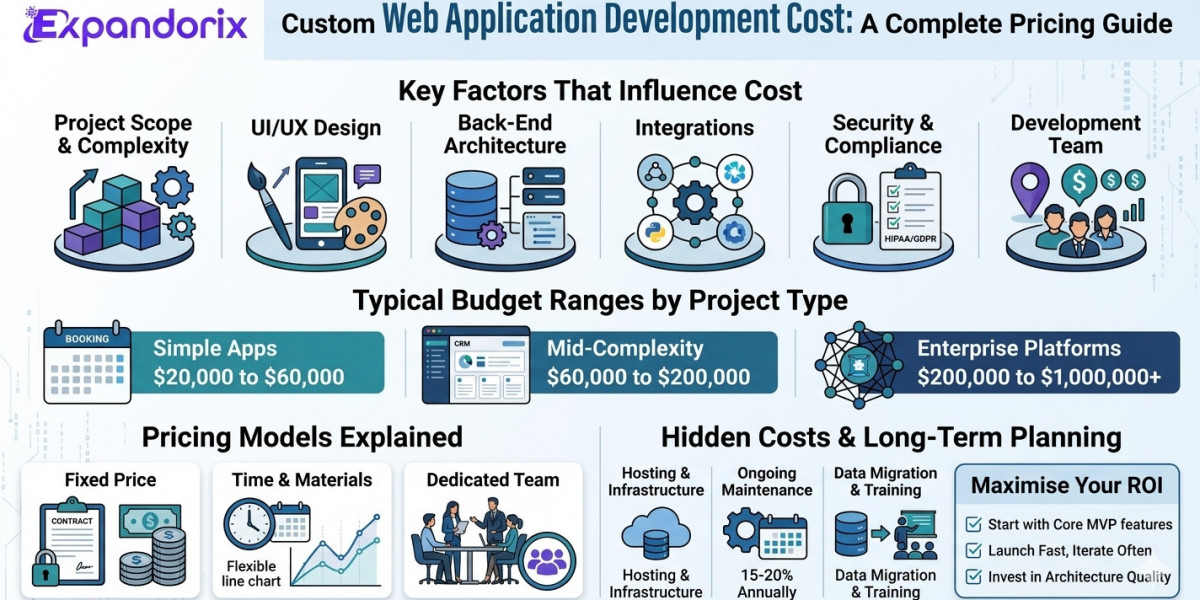

One of the first questions business decision-makers ask when exploring custom web application development is: how much will it cost? It is an entirely reasonable question, but one that is notoriously difficult to answer without context. Unlike purchasing a commercial software licence with a published price list, custom development costs vary enormously based on a wide range of technical, operational, and market factors.
This comprehensive guide breaks down the key cost drivers, provides realistic budget ranges for different types of projects, explains the various pricing models used by development companies, and offers practical guidance on how to maximise the value of your investment.
Why Custom Web Application Costs Vary So Widely
The cost of a custom web application can range from tens of thousands of dollars for a relatively simple tool to several hundred thousand or even millions of dollars for a complex enterprise platform. This enormous range reflects the genuine complexity of software development as a discipline. Consider the analogy of building a physical structure — the cost difference between a garden shed and a skyscraper is not arbitrary; it reflects fundamental differences in scope, materials, engineering, and labour.
The same principle applies to custom web applications. A simple booking form with a database backend is a fundamentally different undertaking from a real-time collaboration platform with AI-powered analytics, complex role-based access controls, and integrations with dozens of third-party systems. Understanding the specific factors that drive cost is essential for setting realistic expectations and making smart investment decisions.
Key Factors That Influence Custom Web Application Development Cost
Project Scope and Feature Complexity
The most significant cost driver is the breadth and complexity of the features you need. A project with ten clearly defined features delivered in a sequential, non-interactive manner is far simpler than one with fifty interdependent features that include real-time data processing, complex business logic, and sophisticated user interactions. The more features you need, and the more complex those features are, the more development time is required and the higher the cost.
Feature complexity is not just about quantity. A single feature such as a real-time chat system or a machine learning recommendation engine can require more development effort than ten simpler features combined. When scoping your project, focus on the complexity of individual features as well as the overall feature list.
UI/UX Design Requirements
Design is frequently underestimated as a cost driver. A simple, functional interface designed for internal business users requires less design investment than a sophisticated, consumer-facing application where visual polish and interaction design are critical to user adoption and brand perception. Projects that require custom animation, micro-interactions, accessibility compliance, and multi-device optimisation will incur significantly higher design costs.
Back-End Architecture Complexity
The server-side architecture of your application — the systems that store data, process business logic, manage authentication, and communicate with third-party services — is often where the greatest technical complexity lies. Applications with simple CRUD operations and straightforward data models are relatively inexpensive to build. Applications requiring real-time data processing, complex transaction management, sophisticated caching strategies, or distributed microservices architectures command significantly higher development costs.
Integration Requirements
Every third-party system your application needs to connect with adds cost and complexity. Simple integrations using well-documented REST APIs are relatively straightforward. Integrations with legacy systems, complex enterprise platforms like SAP or Salesforce, or systems with poor API documentation can require significant engineering effort. The number and complexity of integrations should be carefully evaluated when estimating project cost.
Security and Compliance Requirements
Applications that must comply with stringent regulatory frameworks such as HIPAA, PCI-DSS, GDPR, or SOC 2 require additional investment in security architecture, access controls, audit logging, encryption, and compliance documentation. Industries such as healthcare, finance, and legal services typically face higher development costs as a result.
Technology Stack Choices
The choice of technology stack affects both development cost and ongoing maintenance cost. Some technologies have larger talent pools, making development resources more readily available and potentially less expensive. Others require highly specialised expertise that commands premium rates. Emerging technologies may offer technical advantages but require more senior engineers who are familiar with them.
Development Team Location and Experience
Developer day rates vary significantly by geography and experience level. Senior developers in the United States or Western Europe typically charge significantly more per hour than equally skilled developers in Eastern Europe, Southeast Asia, or Latin America. However, lower hourly rates do not always translate to lower total project cost — factors such as communication efficiency, technical quality, and rework rates can significantly affect the final bill.
Typical Budget Ranges by Project Type
Simple Web Applications: $20,000 to $60,000
At this budget level, you can expect a focused web application with a limited feature set, standard UI components, basic authentication, and simple database interactions. Examples include internal productivity tools, basic customer portals, simple booking or scheduling systems, and straightforward content management systems. These projects typically take three to six months to deliver.
Mid-Complexity Web Applications: $60,000 to $200,000
This budget range accommodates more sophisticated applications with multiple user roles, complex business logic, third-party integrations, custom UI design, and mobile responsiveness. Examples include comprehensive CRM systems, e-commerce platforms with custom features, project management tools, and industry-specific workflow automation systems. These projects typically take six to twelve months.
Complex Enterprise Applications: $200,000 to $1,000,000+
At the higher end of the budget spectrum, you can build sophisticated enterprise platforms with real-time data processing, advanced analytics, complex integration ecosystems, AI and machine learning features, strict compliance requirements, and high-availability infrastructure. Examples include financial trading platforms, healthcare management systems, large-scale e-commerce ecosystems, and enterprise resource planning tools. These projects often take twelve to twenty-four months or longer.
Pricing Models in Custom Web Application Development
Fixed Price
Under a fixed-price engagement, the development company commits to delivering a defined scope of work for a predetermined price. This model provides budget certainty and is appropriate when requirements are well-defined and unlikely to change significantly during development. The risk with fixed-price contracts is that any ambiguity in the requirements can lead to disputes about scope, and both parties may be incentivised to prioritise speed over quality.
Time and Materials
The time-and-materials model bills the client based on the actual hours worked at agreed rates. This model is well-suited to projects where requirements are expected to evolve during development, where an agile approach is preferred, or where the client wants to retain flexibility about scope. The trade-off is less budget certainty — the final cost depends on how much time the project actually takes.
Dedicated Team
Some development companies offer a dedicated team model where a defined team of developers, designers, and project managers are assigned exclusively to your project for a monthly retainer. This model is particularly well-suited to ongoing product development where continuous iteration is planned. It combines the benefits of time-and-materials flexibility with the consistency of a committed team.
Hidden Costs to Budget For
When budgeting for custom web application development, it is important to account for costs beyond the core development engagement:
Infrastructure and Hosting: Cloud hosting, database services, content delivery networks, and monitoring tools all have ongoing costs.
Third-Party Licences: APIs, libraries, and services required by the application may carry licence fees.
Security Audits: Independent security testing and penetration testing should be budgeted separately from development.
Content and Data Migration: If the application replaces an existing system, migrating historical data can be a significant undertaking.
User Training: Onboarding your team to a new system requires documentation, training sessions, and support.
Ongoing Maintenance: Plan for an annual maintenance budget of approximately fifteen to twenty percent of the initial development cost.
How to Maximise ROI on Your Custom Web Application Investment
Getting the best return on your custom web application investment requires more than choosing the cheapest development option. It requires strategic thinking about the scope of the project, the technology choices made, and the ongoing evolution of the application.
Start by focusing the initial development scope on the core features that deliver the most immediate business value. Resist the temptation to build every feature you can imagine upfront — an iterative approach that launches core functionality quickly and adds features based on real user feedback typically delivers better outcomes than trying to build everything at once.
Invest appropriately in architecture and technical quality at the outset. Cutting corners to reduce initial costs almost always results in higher costs later in the form of technical debt, performance issues, security vulnerabilities, and difficulty adding new features.





